Sunday, September 29, 2024

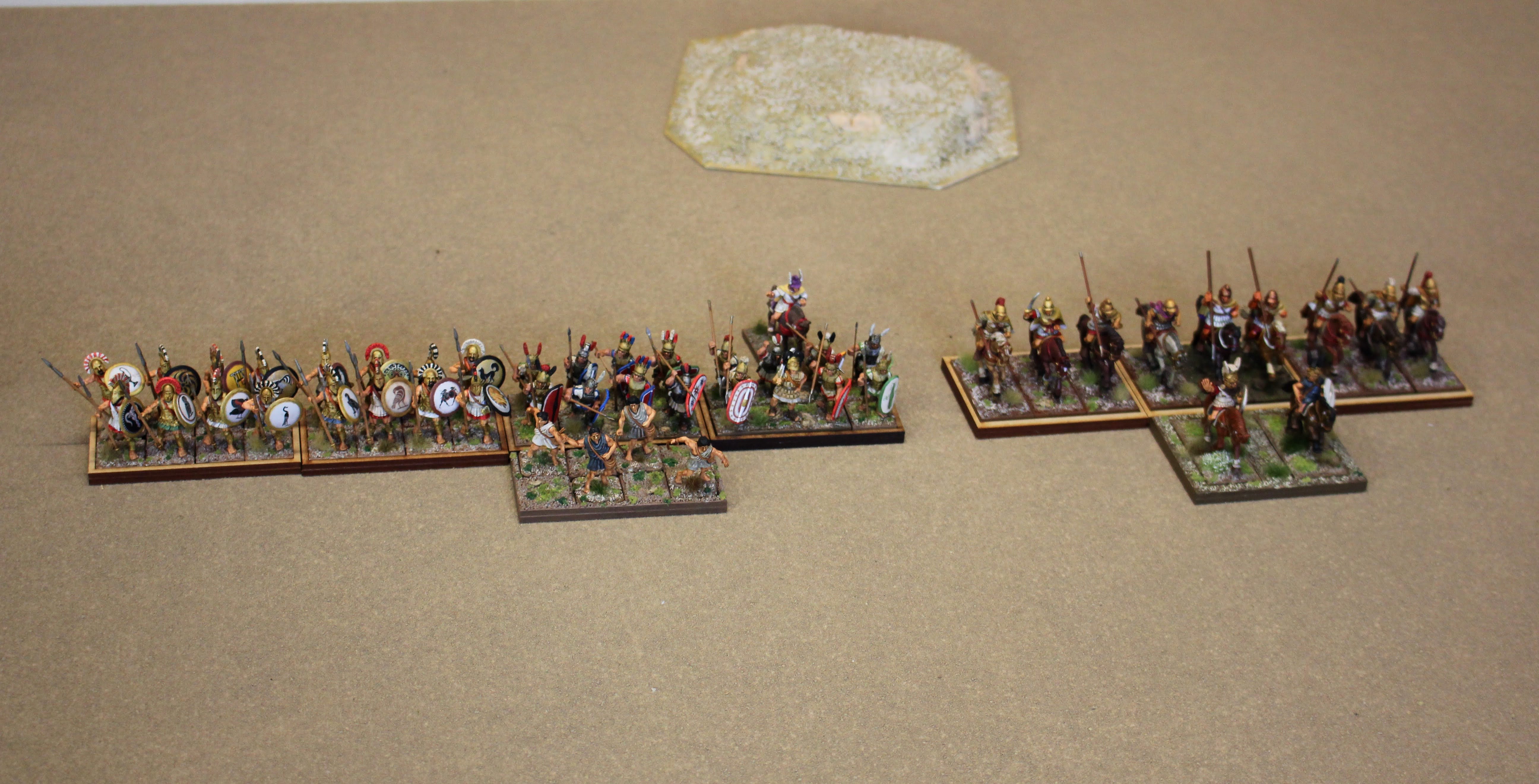
Blemmye Cavalry and More Infantry


Here are some Blemmye cavalry and more archers and javelin men for my 15mm Blemmye and Nobotae army. Figures are by Forged in Battle and Donnington Miniatures. The Nobotae king with the crown next to the standard and the cavalry figures on the left are Donnington, the rest are Forged in Battle. It's been pretty quiet on the gaming and painting front lately, I had a stack on my mtb and hurt my ribs so haven't been up to much for a while. I now have enough painted Blemmye for a Lion Rampant game and have some Forged in Battle Middle Imperial Romans as well as Legio Heroica Late Romans to paint and use as opponents.


Blemmye so far - elephants, cavalry,
archers and javelin men


Sunday, September 15, 2024

Early Carthaginians versus Pyrrhus in Sicily


Armies deployed from the Epirot side


From the Carthaginian side


Epirot right flank


Epirot centre all pike


Epirot left flank


Carthaginian right flank


Carthaginian centre


Carthaginian left flank


Epirot attackers advance


Last Sunday afternoon I played a solo early Carthaginians versus Pyrrhus of Epirus, in Sicily 277-275 BC, ADLG game out in the shed. I knew this would be a very one sided game so included some of the best early Carthaginian troops like the four horse heavy chariots and Sacred Band even though they were most unlikely to have been in use in this late period in Sicily. The chariots performed quite well but otherwise the Carthaginians proved to be no match for Pyrrhus' Epirot army and were slaughtered very easily indeed.


Carthaginians attempt to plug the gaps in their line


Carthaginian left flank


Carthaginian right flank


Carthaginian centre is a mess


Combat on the left flank


Combat on the right flank


Pike charge in the centre


Carthaginians are slaughtered


Sunday, September 8, 2024

Saladin and More Horse Archers


Here is a Gripping Beast Saladin figure and some more Perry Seljuk and Turcoman horse archers that I've finally finished painting. I'm currently reading Jonathan Phillips' book The Life and Legend of the Sultan Saladin which is very interesting.


Thursday, August 29, 2024

First Game of 'Alala! - Spartans versus Athenians


Armies deployed from the Athenian side


From the Spartan side


Spartans advance


'Alala! rules and QRS


Athenian light cavalry shoot


Heavy cavalry shoot


Last Wednesday afternoon Craig came over and we played our first game of 'Alala! with Spartans versus Athenians in the Peloponnesian War. The 'Alala! rules are written by Simon MacDowall, published by the Society of Ancients and are designed for battles between Greek city states during the Peloponnesian and Boeotian Wars of the fifth and fourth centuries BC. The rules are in colour, 24 pages, include a QRS sheet and a God Pack of cards. 'Alala means battle cry in Greek. They use a turn sequence of dicing for Initiative, Command Actions, Control Tests, Skirmish Actions, Phalanx Movement, Charges, Combat and After Combat Moves. Movement is variable with average dice and shooting and combat is resolved with D6 dice. Command and Control is managed by leaders attached to individual hoplite units, who must deal with Disorganisation Points and Causes while trying to raise Agression Levels and Morale.

Craig's Athenians and allies had three leaders, four Class B hoplite units, a heavy and light cavalry unit, a unit of peltasts and three units of psiloi. My Spartans and allies were very similar with three leaders, three Class A Spartan hoplite units, one allied Class B hoplite unit, a heavy and light cavalry unit, a unit of peltasts and two units of psiloi. I had the Initiative for most of the early turns in the game and the Spartans advanced with the psiloi, peltasts and cavalry shooting. The Spartan heavy cavalry and Athenian light cavalry charged on separate flanks, after combat both sides rode through their opponents. After advancing for quite a few turns the Spartan and allied hoplites charged on the flanks and the Spartan hoplites eventually charged in the centre. 

Hoplite combat was attritional with hits on 5 and 6 with a maximum of 12 dice and various modifiers including support, Eager, Ready, Disorder Points and Shaken. Results of combat are then worked out depending on the differences in hits for each side. In the end we ran out of time, the Athenian allied hoplite unit on the right was shaken and two Spartan hoplite units in the centre were retiring but a result still seemed a fair way off. I like how these rules are written for a specific period instead of the usual vast 4,000 thousand year time span of most ancient rules. No doubt as a first game we got a few things wrong. They have a number of interesting and innovative features and invoking the God Pack of cards is a lot of fun. Whether you would like them depends a lot on your personal taste in rules and the mechanics used. Personally I'm not a big fan of variable movement with dice and prefer combat where there are modifiers for the quality of troops involved.


Side view


Spartan heavy cavalry charge


Athenian light cavalry charge


Peltasts charge in the centre


Hoplite units charge on the flanks


Athenian allied hoplites are shaken,
Spartan hoplites retiring in the centre


Tuesday, August 27, 2024

Anglo-Saxon Ceorls


Here are some Anglo-Saxon Ceorls that I've just finished painting. These are all old Gripping Beast metal figures. I don't think they're still available but I really like the shield wall poses they are in. Their shields are a mix of LBM transfers and hand painted. As ceorls they're more likely to be part of the Great Fyrd rather than the Select Fyrd who were usually armoured thegns.


Wednesday, August 14, 2024

Carthaginians versus Republican Romans ADLG Game


View of the table from the Carthaginian side


From the Roman side


Side view


Carthaginian left flank


Carthaginian centre


Last Tuesday afternoon Craig came over and we played a Second Punic War game set in Spain out in the shed. Craig commanded the Roman defenders with Celtiberian allies and I commanded the Carthaginian attackers also with Celtiberian allies. The Carthaginians advanced and attacked while the Romans held back. There was a marsh near the river on the Carthaginian left flank which hindered movement and prevented the Carthaginians from exploiting their cavalry advantage. 

Both flanks and the centre of the two armies were engaged in combat and slowly but surely the Romans ground the Carthaginian forces down as usual. On the Carthaginian right flank a single unit of Roman allied Iberian cavalry tied up three units of Carthaginian Gallic cavalry and routed two of them. However the infantry combat on this flank went the way of the Carthaginians with the Spanish Scutarii out performing their Celtiberian rivals. In the centre and on the Carthaginian left flank combat favoured the Romans. In the end both sides were still a fair way from breaking but the Romans had the best of the encounter to claim a minor victory.


Carthaginian right flank


Roman commander


Carthaginian commander


Combat in the centre


Combat on the Carthaginian right flank


Ilium: A Game of Heroes - Night Mission

  Sleeping Thracian warriors with Rhesus' chariot in the centre Diomedes and Odysseus deployed, Odysseus is near the chariot Odysseus es...